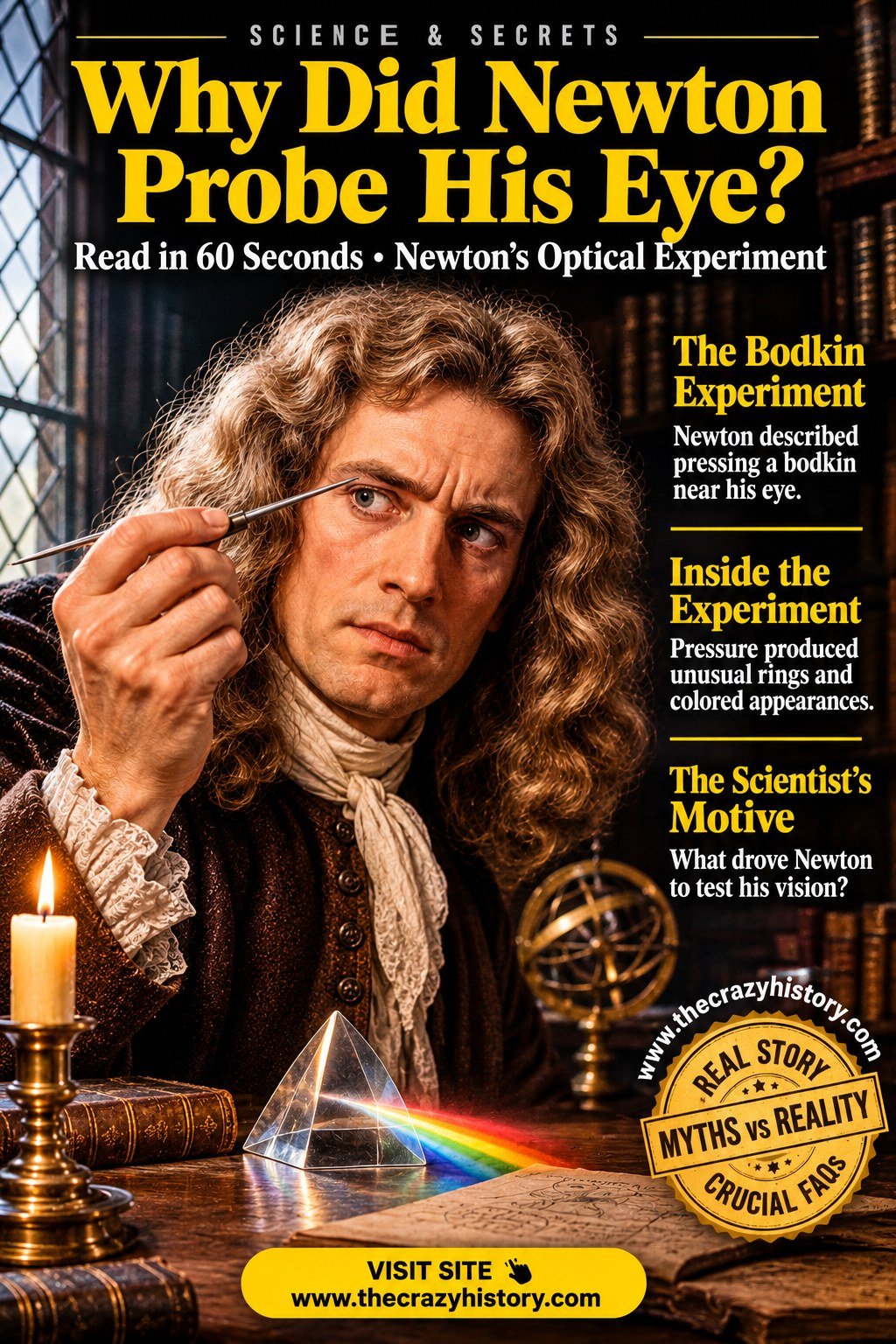
Isaac Newton Eye Experiment: the Perilous Bodkin Trial
In a shuttered chamber lit only by the faint silver glare of a window slit, a solitary young scholar sits motionless before a looking glass, sliding a blunt, flat brass sewing needle deep into the narrow socket between his eyeball and the surrounding bone. With agonizing precision, he presses the cold metal tip against the back of his own living eye until ghostly circles of violet, white, and dark color bloom across his darkened field of vision. Far from an act of madness, this perilous self-experiment unfolded in Cambridge, England, around 1665, when a twenty-two-year-old Isaac Newton turned his own body into a laboratory instrument to unlock the physical laws of human sight—begging a chilling question: how far was the founder of modern physics willing to go before risking permanent blindness?
1The Brass Bodkin and the Solar Gaze
Step 1: Isolating the Enigma of Color in a Plague-Stricken Town
During the Great Plague outbreak of 1665–1666, Trinity College, Cambridge closed its doors, sending Isaac Newton back to his family estate at Woolsthorpe Manor in Lincolnshire. Obsessed with refuting René Descartes’ theory that light was merely mechanical pressure transmitted through an invisible medium, Newton began recording private trials inside his leather-bound student notebook titled Quaestiones Quaedam Philosophicae.
Step 2: Sliding the Bodkin Behind the Eye Socket
To test whether physical deformation of the retina alone could manufacture colors without a single ray of external light entering the pupil, Newton took a blunt, flat-headed sewing tool known as a bodkin. Carefully slipping the shaft between his eye and the orbital bone as close to the back of the eyeball as his fingers could reach, he pressed inward and recorded the vivid, concentric rings of light and darkness that erupted inside his vision.
Step 3: Staring Directly Into the Noon Sun
Not content with mechanical pressure, Newton pushed his ocular endurance even further by staring directly at the blazing sun reflected in a mirror with his right eye until his vision dissolved into blinding brilliance. After turning away into a pitch-dark room, he tracked the lingering spectral afterimages—watching red, blue, and yellow phantoms pulse across his sight every time he blinked or focused on a white wall.
After repeated solar gazing trials, Newton burned an image of the sun so deeply into his retina that fiery phantoms haunted both his open and closed eyes for days—forcing him to lock himself inside a completely darkened room for three consecutive days and nights to save his eyesight from permanent destruction.
2Clinical Genius vs. Reckless Self-Experimentation
The Empirical Precision of a Master Physicist
Every sensation inside Newton’s bruised eye was measured with cold, geometric discipline. He documented exact shapes, color gradients, pressure angles, and recovery intervals, proving that perceived color arises from physical vibrations and pressure stimulating the retina rather than mystical qualities floating in the air.
The Compulsive Obsession That Ignored Pain
Beneath the serene portrait of the celebrated scientist lived a fiercely solitary perfectionist who distrusted secondhand reports. Newton refused to accept any anatomical claim until he felt it firsthand, routinely endangering his vision, tasting toxic heavy metals like mercury, and sacrificing sleep until physical collapse intervened.
3Popular Myths vs. Documented Archival Truth⇄ Swipe to explore
Newton pierced the front of his eyeball with a sharp sewing needle to drain ocular fluid.
He used a blunt, flat-headed bodkin slid safely alongside the outside of the eyeball without puncturing tissue.
The bodkin trial was an accidental childhood mishap before Newton ever studied optics.
It was a deliberate, step-by-step scientific experiment recorded in his Trinity College research notebook.
Newton permanently blinded his right eye during the bodkin and sun-staring experiments.
After three days in total darkness, his vision recovered completely and remained sharp well into his eighties.
His eye pressure test proved that white light is made of seven rainbow colors.
The bodkin tested retinal mechanics; glass prisms in his darkened room proved the color spectrum of white light.
Newton boasted publicly about the needle experiment to shock the Royal Society in London.
He kept the graphic bodkin notes locked in a private notebook that remained unpublished for centuries.
Only one eye experienced solar afterimages after Newton stared into his looking glass.
Remarkably, Newton noted that faint spectral rings began appearing even when he looked with his untouched left eye.
4Primary Record & Sworn Eyewitness Testimony
“I took a bodkin & put it betwixt my eye & the bone as neare to the backside of my eye as I could: & pressing my eye with the end of it (so as to make the curvature a, bcdef in my eye) there appeared severall white darke & coloured circles r, s, t, etc. Which circles were plainest when I continued to rub my eye with the point of the bodkin, but if I held my eye & the bodkin still, though I continued to presse my eye with it yet the circles would grow faint & often disappeare untill I removed them by moving my eye or the bodkin.”
— Isaac Newton, Quaestiones Quaedam Philosophicae (Cambridge University Library MS Add. 3996, c. 1665)5From Darkened Chamber to Modern Visual Science
Following his sun-staring experiments, Newton endured days of blinding solar afterimages whenever he glanced at bright surfaces. Confining himself to total darkness for seventy-two hours, he slowly trained his mind to stop dwelling on the phantoms until his bruised retinas healed completely.
Newton’s firsthand discovery of pressure-induced light flashes—known today as phosphenes—and retinal afterimages laid the empirical bedrock for his landmark 1704 treatise Opticks, transforming ophthalmology, visual neuroscience, and modern physics forever.
Newton’s private notebook stayed hidden inside his personal library until his death in 1727, eventually passing into the archives of Cambridge University Library. Remarkably, despite subjecting his eyes to brass needles and direct sunlight in his youth, Newton never needed spectacles until old age and died at eighty-four with his eyesight intact.
6The Phantom Transfer Between Newton’s Eyes
In a 1691 letter to philosopher John Locke recounting his solar-gazing ordeal, Newton revealed an astonishing detail: although he stared at the sun exclusively with his right eye while keeping his left eye shut, the fiery spectral afterimage eventually began appearing in his unexposed left eye whenever he looked at bright objects. Modern neuroscientists recognize this phenomenon as interocular transfer inside the visual cortex rather than physical damage to the left retina—yet because no clinical instruments existed in the seventeenth century, historians still debate how severe Newton’s temporary photochemical burn actually was and why his visual system recovered without permanent central scarring.
7Frequently Asked Questions (FAQs)
Q: Did Isaac Newton really stick a needle in his eye?
A: Yes, around 1665 Isaac Newton slid a blunt, flat sewing bodkin between his eyeball and eye socket to press the back of his eye. He never punctured the eyeball itself, using controlled mechanical pressure to test whether physical distortion of the retina could produce perceptions of light and color in the dark.
Q: What happened when Isaac Newton pressed his eye with a bodkin?
A: Pressing the blunt tip against the rear curve of his eyeball generated concentric white, dark, and colored circles across his vision. Newton observed that the rings remained brightest while the bodkin or eye moved slightly, but faded away whenever both remained completely stationary.
Q: Why did Isaac Newton stare at the sun in a mirror?
A: Newton stared at the sun’s reflection with his right eye to investigate how intense light stimulates the retina and creates lingering colored afterimages. The experiment succeeded so powerfully that fiery solar phantoms persisted for days, forcing him to spend three days in total darkness to recover.
Q: Did Isaac Newton go blind from his eye experiments?
A: No, Isaac Newton made a full recovery after resting his eyes in a completely darkened room for three consecutive days. Despite both the bodkin pressure trials and his solar-gazing experiments, he retained functional vision throughout his life and lived to age eighty-four.
Q: What scientific phenomenon did Newton’s bodkin experiment discover?
A: Newton’s bodkin trial provided one of the earliest systematic descriptions of pressure phosphenes—visual sensations of light and color triggered by mechanical pressure on the retina rather than photons. His findings proved that color perception is generated within the eye and brain rather than existing solely as an external substance.
Newton unlocked the laws of light and human vision because he refused to trust anyone’s eyes except his own—even when it nearly cost him his sight. Where do you draw the line between fearless scientific curiosity and dangerous self-experimentation?
Join the Discussion ↓